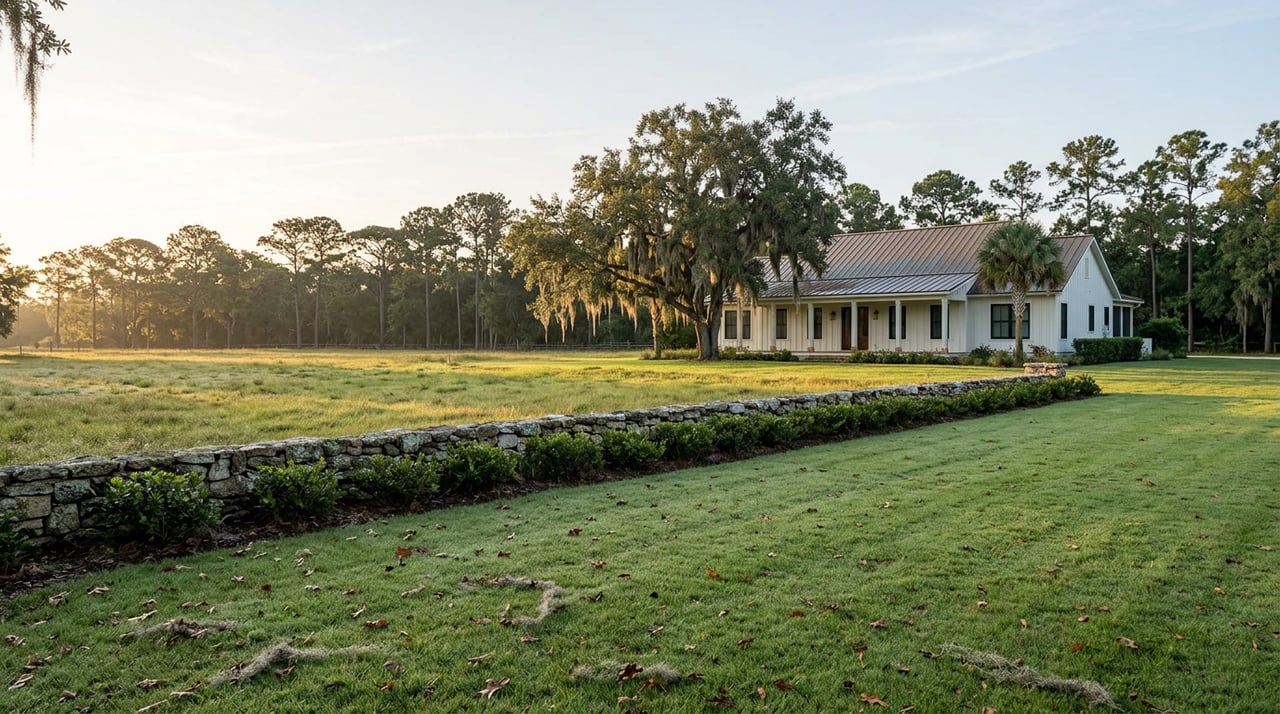
Drive US-301 through Parrish and you'll still pass fields with cattle in them, tucked between subdivision entrances and construction fencing. For years, the working assumption among buyers has been that those fields are a kind of insurance policy: the owner isn't selling, the zoning keeps it agricultural, and the view stays open. As of July 1, 2026, that assumption needs a second look. A new Florida law didn't rezone anything by itself, but it did hand the owners of some of those fields a fast, largely automatic path to development that didn't exist six months ago. Whether a given pasture is a permanent buffer or a subdivision waiting on paperwork now depends on math almost nobody outside a land-use attorney's office knows how to run.
The law is Senate Bill 686, signed by Governor Ron DeSantis on April 21, 2026 and now codified in the Florida Senate's bill file as Chapter 2026-34. It rewrites how "agricultural enclaves" get certified for development. For a growth corridor like Parrish, where ranch land sits wedged between master-planned communities on nearly every side, this is not an abstract statehouse story. It's a mechanism that changes what a neighboring farm is actually worth, and what it might become.
The 75 Percent Rule Hiding in Plain Sight
An agricultural enclave, under the revised statute, is a single-owned, undeveloped agricultural parcel that sits mostly boxed in by land already built out or designated for development. The qualifying test comes down to a perimeter measurement: at least 75 percent of the parcel's boundary has to border property already zoned or designated for industrial, commercial, or residential use. Get past that threshold, and the county's traditional power to say no through zoning discretion mostly disappears.
A few details matter more than they first appear to:
- The property has to have already met the criteria as of January 1, 2025. A field that only became "surrounded" after that date doesn't qualify under this window.
- Ownership has to be single, not fragmented across several unrelated owners.
- The land needs five straight years of documented, bona fide agricultural use immediately before the application, per the standard set in Florida Statute 193.461.
- Size is capped at 1,280 acres, or up to 4,480 acres if the surrounding development is dense residential.
- Manatee County's population sits well under the law's 1.75 million cap, so nothing about county size disqualifies parcels here the way it would in Miami-Dade or Broward.
- Florida Politics lists the Everglades Protection Area, the Wekiva Study Area, and recorded conservation easements among the excluded categories.
None of this shows up on a listing sheet. It shows up when someone runs the parcel's boundary against a future land use map, which is exactly the kind of due diligence that separates a casual look at acreage from a serious one.
What Used to Take Two Years Now Takes Ninety Days
Before this law, an owner of an agricultural enclave who wanted to develop had to go through a full comprehensive plan amendment. The Dirt Dog reports that process routinely ran 12 to 24 months and still ended with no guarantee the county commission would approve it.
SB 686 replaces that with a fixed clock:
- The landowner applies directly to the county or municipality for enclave certification.
- The local government has 30 days to issue a written report on whether the parcel meets the criteria.
- Within 30 days of that report, the county must hold a public hearing to approve or deny certification.
- If the county doesn't make a decision within 90 days of the original application, the parcel is automatically certified as an agricultural enclave, whether or not anyone voted on it.
| Old comprehensive plan amendment | SB 686 enclave certification | |
|---|---|---|
| Typical timeline | 12 to 24 months or longer | Up to 90 days, often less |
| Approval standard | County commission discretion | Administrative, largely non-discretionary |
| Default if county delays | Application stalls | Automatic certification |
Once a parcel is certified, the owner can submit development plans for single-family housing matching the density of whatever is next door, and the county has to treat that plan as a conforming use. If the certified parcel sits along an interstate, commercial and industrial development can be on the table too. This certification track runs through January 1, 2028. After that, the law reverts to the older, slower process unless the legislature extends it, which means the practical window for a landowner to use this path is about 18 months.
Parrish Is Almost a Textbook Case
Parrish didn't need this law to explain why it's growing. It's been one of the most active new-construction corridors in the Tampa Bay region for close to a decade, built on land that was ranch and tomato fields well into the 2000s. What the law does is put a name and a deadline on something that was already happening on the ground: agricultural parcels quietly losing their surrounding open space until they're islands.
North River Ranch, developed by Neal Land & Neighborhoods, is the scale reference for how far that process has already gone. The community is approved for 5,000 homes, and as of early 2025, roughly 1,200 were occupied. According to Your Observer, Neal Land & Neighborhoods president John Neal said:
"So we're just over a fifth completed."
That means roughly four-fifths of a 5,000-home approval is still ahead, which tells you how much perimeter is still being drawn around whatever agricultural land sits adjacent to it. Add Gamble Creek Estates, marketed specifically for buyers wanting larger lots and rural character within the same growth corridor, plus Creekside Commons, a 300,000-square-foot shopping center off US 301 that opened in 2023 and was reported as more than 92 percent leased in early 2025, and the pattern is clear. Sea Air, a 1,500-plus acre community planned for around 3,600 single-family homes and 400 multifamily units, is filling in more of the same corridor. Add the parallel span planned for the Fort Hamer Bridge and Rye Ranch Elementary, which opened this past August, and you have a growth corridor building perimeter faster than most agricultural landowners are tracking it.
None of this means every remaining ag parcel in Parrish automatically clears the 75 percent threshold. It means the number of parcels that could is climbing every time another phase of North River Ranch, Gamble Creek, or a new mixed-use proposal along US 301 gets approved.
Two Different Bets This Changes
For a buyer choosing acreage partly because of the open field or working ranch next door, the calculation used to be simple: agricultural zoning meant that land would stay agricultural for the foreseeable future, absent an unlikely comprehensive plan fight. That's no longer a safe assumption if the neighboring parcel meets the enclave criteria. The honest version of this due diligence isn't just checking the zoning on the parcel you're buying. It's checking whether the field next to it could qualify for expedited certification, and if so, what density the surrounding approved developments already carry, since that's the density the enclave would be entitled to match.
For someone holding legacy agricultural land in the same corridor, maybe inherited, maybe purchased decades ago before the growth arrived, the math runs the other direction. A parcel that's been locked into agricultural use because the zoning discretion always favored denial may now have a fast, largely automatic path to residential value, but only through January 1, 2028. Waiting past that date without applying means falling back to the old 12-to-24-month process with no guarantee of approval.
The Window Doesn't Guarantee Anything
Early cases outside Parrish are worth watching, because they show this process is not a rubber stamp. In Martin County, an application for a 396-acre property called Waterside, spanning three parcels near Kanner Highway, was filed the same day the law took effect. County staff recommended denying the certification after finding that not all three parcels carried the required continuous agricultural classification. In Orange County, a contested 1,400-acre site known as Sustanee, which has seen at least six development proposals since 2009, went to a public hearing on August 25, 2026 specifically to determine enclave eligibility, with opponents arguing the land functions as a transitional wildlife buffer rather than an isolated agricultural pocket. Details on both cases are covered by WFLX and GrowthSpotter.
The lesson for Parrish is the same one that applies to any due diligence on rural land: paperwork has to match reality. A parcel that looks surrounded on a map can still fail certification if its tax records show gaps in continuous agricultural use, or if part of its boundary touches a protected corridor rather than a subdivision. A detailed legal analysis from Stearns Weaver Miller walks through these mechanics for anyone who wants the statute-level detail before making a decision.
A Few Questions Worth Asking Before You Assume Anything
Does this change the agricultural tax classification on land I already own? No. The enclave certification under SB 686 is a land-use and development pathway. The Greenbelt agricultural classification under Florida Statute 193.461 is a separate property tax classification. A parcel can be certified as an agricultural enclave and still carry a different status for tax purposes, and vice versa. Talk to your county property appraiser's office about how the two interact for your specific parcel.
Is there a minimum lot size where this stops applying? The statute caps enclaves at 1,280 acres, or 4,480 acres if the surrounding development is dense residential. There's no stated minimum, but the 75 percent perimeter rule and five-year continuous agricultural use requirement do most of the practical filtering on smaller parcels.
What happens if a landowner doesn't apply before January 1, 2028? The fast-track certification process reverts to the pre-2026 rules, meaning any future development request goes back through the traditional comprehensive plan amendment process, with the longer timeline and no guarantee of approval that came before this law.
Does a small hobby farm qualify the same way as a large ranch? Size alone doesn't disqualify a property, but the five-year continuous bona fide agricultural use standard and the 75 percent surrounding-development test apply regardless of acreage. A property's actual use history and its boundary relationship to adjacent zoning matter more than how large it is.
This law rewards exactly the kind of parcel-by-parcel reading that generic acreage searches skip over. A field's fence line tells you what's there today. It doesn't tell you what's already been approved next door, or how close that field sits to a threshold that changes everything about its future. If you're weighing a purchase near Parrish's growth corridor, or sitting on agricultural land that's slowly been surrounded by it, Houses with Hart can walk the boundary with you and help you read what the map is actually telling you before you buy, sell, or wait.
This article is general information, not legal, tax or financial advice. Consult a qualified professional about your situation.